Dotonbori, Osaka: The Citywide Smoking Fine, the Canal You Stay Out Of — and What Locals Actually Say
Genchi Japan — go to the actual place, hear the actual people. Data collected 2026-08-20. Reviewed 2026-08-22.
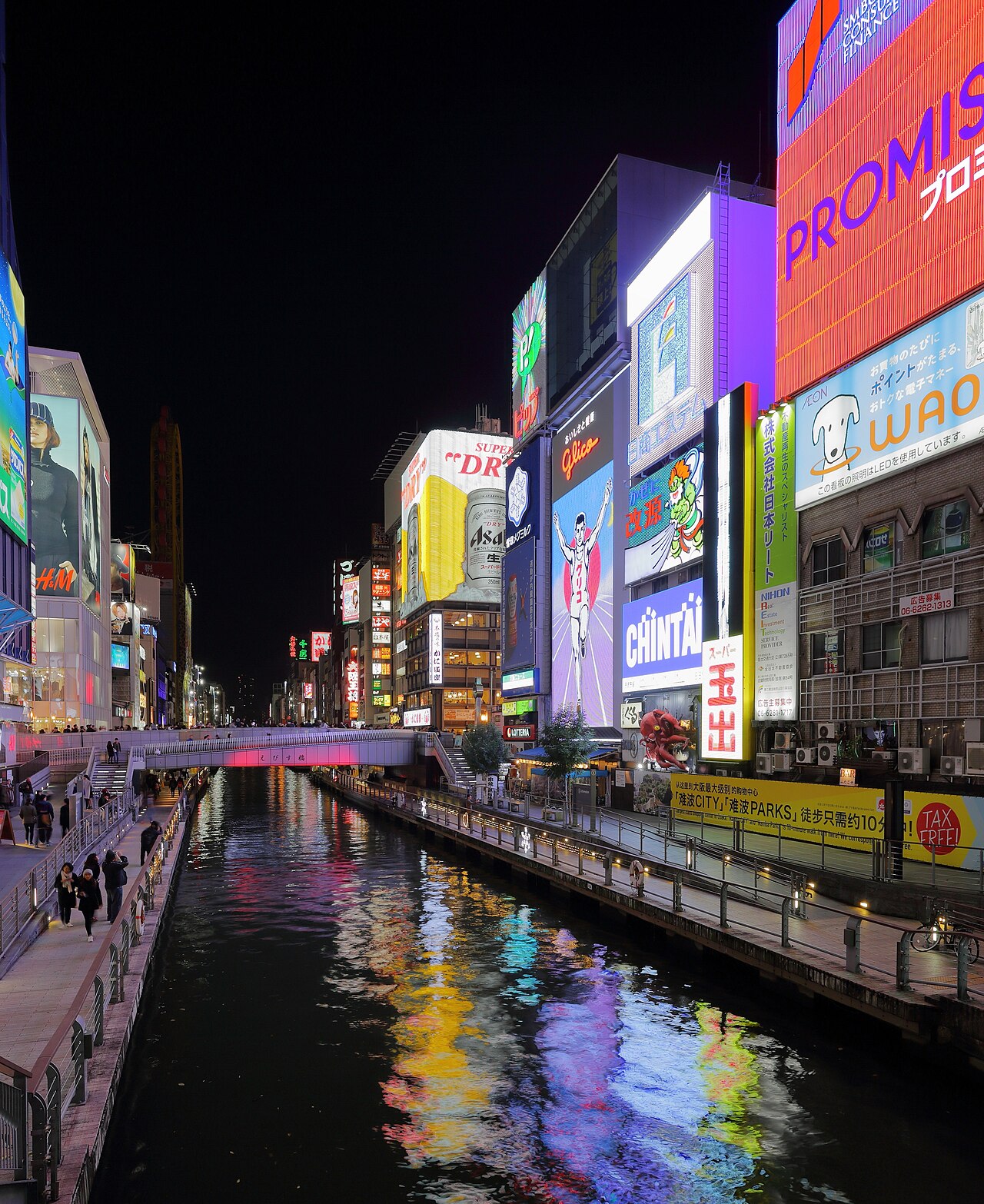
Terms, for first-timers: Dotonbori is Osaka's neon entertainment strip along a canal of the same name, in the Namba area of central Osaka. The Glico sign (a running man, a confectionery company's billboard since 1935) is the photo everyone takes from Ebisubashi bridge. Takoyaki are octopus dumplings — Osaka's signature street food, served in a little paper "boat." A konbini is a convenience store. The Hanshin Tigers are Osaka's beloved pro baseball team. Expo 2025 was the World Expo held in Osaka. Tatemae = the official face; honne = what people really think. ¥1,000 is roughly US$7.
📜 THE TATEMAE — the official rule
Smoking on the street is banned everywhere in Osaka City — with a ¥1,000 fine.
- Since January 27, 2025, the street-smoking ban covers the whole city — all city-managed streets, plazas and parks — not just designated districts. Heated tobacco (IQOS etc.) counts too (Osaka City official[EN], ordinance text[EN]).
- Unlike Shibuya's no-fine drinking ban, this one has teeth: city patrol staff who see you smoking issue the ¥1,000 penalty on the spot (Osaka City Environment Bureau — 過料徴収及び指導体制について, March 2023, PDF: the fine is 違反現場での即時納入(現金徴収), and by ordinance only a 路上喫煙防止指導員 may impose it, after 違反行為の現認 — witnessing the act).
- Littering is separately prohibited by a city ordinance dating from 1995 (Osaka City — anti-littering ordinance[EN]) — and Dotonbori has almost no public trash cans. Osaka City removed its street bins years ago; the city's own explanation of why is no longer on its website, so I am not going to state a reason for it here. The national version of this story is separately sourced.
- Not a law but a matter of life and death: do not jump into the Dotonbori canal. People have died doing it — one fatality in 2003, when an estimated 5,300 people jumped after a Hanshin Tigers championship (Number Web[EN]), and another in 2015. It's filthy, the drop from the bridge is about 2.5 m, the water is deep (around 3.4 m) and followers landing on top of you are the real danger (water-safety expert analysis, Yahoo! News[EN]).
📋 Rules at a glance
| Act | Rule | Penalty | Since | Level / authority | Source |
|---|---|---|---|---|---|
| Smoking on the street (incl. heated tobacco) Osaka City — all city-managed streets, plazas and parks | Prohibited citywide | ¥1,000 on-the-spot fine | 2025-01-27 | city Osaka City ordinance | Osaka City official (city-wide ban, ¥1,000 過料) verified 2026-09-07 |
| Littering (cans, bottles, cigarette butts etc.) Osaka City | Prohibited by city ordinance | None in the ordinance itself — the city can advise, then order, then publish the name of anyone who ignores it (arts. 6 and 8) | 1995-11-01 | city Osaka City anti-littering ordinance (空き缶等の投げ捨て等の防止に関する条例) | Osaka City official — text of the ordinance verified 2026-09-07 |
The rules that apply here, one row each, with the authority level, the penalty and a source a human has checked. The whole dataset is published as rules.json (CC BY 4.0).
good spot restricted / caution (zones are approximate — always follow on-site signs)
Map: © OpenStreetMap contributors
🗣️ THE HONNE — what locals actually say
Sampled from public Japanese posts on X (via Yahoo! Realtime Search) mentioning Dotonbori and tourists. Summarized and grouped — posts are paraphrased, not reproduced:
| Theme | What it sounds like |
|---|---|
| "We don't go there anymore" | Osakans describing Dotonbori as wall-to-wall tourists and a place locals have no reason to visit. The most common sentiment wasn't anger — it was surrender. |
| The food-quality logic | The most useful idea a local put online: in Dotonbori even a bad takoyaki shop survives, because every customer is a one-time visitor; a takoyaki stand in a residential neighborhood has to be good or locals wouldn't come back. |
| Warmth underneath | Osakans joking that they'd secretly like to buy the nandeyanen sunglasses (a gag souvenir printed with the Osaka-dialect phrase for "you've got to be kidding") and do the full tourist routine themselves. |
Methodology: posts targeting nationalities rather than behaviors were excluded from aggregation.
📊 By the numbers. Two weeks before the citywide ban took effect, a Kansai TV news crew walked central Osaka — around Umeda/Osaka Station and Namba — and counted 44 people smoking on the street in 3.5 hours, 23 of them around Osaka Station alone (Kansai TV, 2025-01-10[EN]). That's a journalists' field count, not an official statistic — but it's the scale of habit the ¥1,000 fine was built to break, and the mayor tied the timing explicitly to the crowds expected for Expo 2025 (same report).
🤔 THE WHY — how it got this way
Dotonbori has been Osaka's entertainment district since the 1600s, when the canal was dug and the city's theaters moved here (Dotonbori Shopping Street Association — history[EN]). The neon spectacle — the Glico runner, the giant mechanical crab — was always a stage set, and locals have long treated it as one. What changed is scale: it became one of Japan's most photographed places, and locals quietly moved their actual eating and drinking one or two streets (or train stops) away.
The citywide smoking ban launched months before Expo 2025 as part of cleaning up the streets for an international-tourism city (Osaka City[EN]). The near-absence of trash cans is a separate policy: the city removed its street bins, so you carry your rubbish until you find a bin — usually back at your hotel. Why the bins went is its own story.
✅ THE MOVE — do this instead
- Smoke only in designated smoking spaces (search Google Maps for "smoking area"; department stores and some konbini have booths). Lighting up while walking costs ¥1,000.
- Carry a small bag for your trash. Eat your takoyaki standing near the stall; if the stall has a return bin, put the paper boat there; take everything else with you back to the hotel.
- Get the Glico photo from Ebisubashi bridge — then step out of the way; the bridge is also a commuter route.
- Eat one meal in Dotonbori for the spectacle — then eat the rest where locals do. Ask your hotel staff where they buy takoyaki, or ride one or two stations out on the subway. This is the single most repeated piece of local advice we found — whether the food is actually better is their claim, not our finding.
- Stay out of the canal. When the Hanshin Tigers win big, ecstatic fans leap in; police close Ebisubashi after big wins (J-CAST, 2023). Watch; don't join.
Sources: Osaka City — city-wide smoking ban[EN] · Osaka City — ordinance[EN] · Osaka City Environment Bureau — 過料徴収及び指導体制について (PDF) · Osaka City — anti-littering ordinance[EN] · Kansai TV — street-smoking field count, 2025-01-10[EN] · Number Web — 2003 canal jumping[EN] · Yahoo! News expert — canal-jumping danger[EN] · J-CAST — 2023 bridge closure · Dotonbori Shopping Street Association[EN] · Local voices: public X posts via Yahoo! Realtime Search, 2026-08-20. Last updated 2026-08-22.
Suggest the next place — or make this page better
Spotted something outdated? Know a place I should cover? Tell me below — it opens right here, no account needed. Every report is verified before publishing.