Why Japan Has No Trash Cans — Where to Put Your Rubbish, and What Locals Really Think
Japan Logic — country-wide honne. Data collected 2026-08-20. Reviewed 2026-08-22.
Terms, for first-timers: a konbini is a convenience store (7-Eleven, FamilyMart, Lawson); a bento is a boxed meal. Honne = what people really think, as opposed to the official line.
🧩 THE PUZZLE
The cleanest big country you've ever visited — and nowhere to throw anything away. You'll walk a long way in Tokyo holding an empty bottle. It feels like a prank. It isn't.
📋 Rules at a glance
| Act | Rule | Penalty | Since | Level / authority | Source |
|---|---|---|---|---|---|
| Disposing of trash when no public bin is available Japan — nationwide | Take it with you; use bins where available | None (guideline, no statutory force) | — | national Japan Tourism Agency — Travel Etiquette for the Future | JTA (EN) verified 2026-09-07 |
The rules that apply here, one row each, with the authority level, the penalty and a source a human has checked. The whole dataset is published as rules.json (CC BY 4.0).
🗣️ THE HONNE — what locals actually say
Here's what most etiquette guides won't tell you: Japanese people argue about this among themselves. Summarized from public Japanese posts on X (posts are paraphrased and grouped, not reproduced):
| Camp | What it sounds like |
|---|---|
| "Carry it home" traditionalists | Accounts of being asked by a tourist where to throw a cup and answering: there isn't anywhere — you carry it back and use the bin at your hotel; that's how it works. |
| The critics (yes, locals!) | Posts pointing out that other cities have more bins than Tokyo, that visitors must find Tokyo bizarrely unfriendly, and that you can't blame tourists for this one. |
| The pragmatists | The observation that we let tourists eat street food and give them nowhere to put the wrapper — of course there's litter. |
| Quiet respect | Admiring descriptions of visitors who carry their own trash around in a bag all day. That tourist understood Japan. |
Methodology: posts targeting nationalities rather than behaviors were excluded; posts are summarized, not reproduced.
🤔 THE WHY — how it got this way
Two different things disappeared, for two different reasons — and the popular explanation conflates them.
Station bins: security. On March 20, 1995, the Aum Shinrikyo cult released sarin nerve gas on the Tokyo subway. The subway operator (then the Teito Rapid Transit Authority, today's Tokyo Metro) pulled every bin from its stations the same day, and other railways removed theirs temporarily (Traffic News[EN]; Merkmal[EN]). Bins came back in April 1997 — fewer than half the previous number (about 500 sets down to 220), placed within staff sightlines (Merkmal[EN]; Yahoo! News expert analysis[EN]). After the 2004 Madrid and 2005 London train bombings, JR East switched to transparent bins and the subway and private railways removed theirs again before adopting see-through models (Traffic News[EN]). Then, in a quieter second wave, railways took them out for good: Seibu in March 2021, Tokyo Metro in January 2022, Toei subway in May 2022 — JR East has kept station bins because of its in-station shops (Merkmal[EN]).
Street bins: hygiene and cost. The analyst whose piece is most often cited on this topic is explicit that the sarin attack is not the direct reason Japan's streets have no bins (Yahoo! News[EN]). Municipal street bins were removed from the 1990s onward because people dumped household and restaurant waste in them, crows scattered it, and emptying them cost money (same analysis[EN]; Merkmal[EN]). Japan already had a deep norm — your trash is your responsibility until you get it home — and removing the bins leaned on it. The missing bin isn't neglect; it's a social contract you've just been invited into.
✅ THE MOVE — do this instead
- Pack one plastic bag per day. Trash goes in the bag; the bag goes in your hotel-room bin. This isn't just folk custom: the Japan Tourism Agency's official traveler guidelines say "Dispose of your waste in trash cans, if available, or take it with you to dispose of later" (JTA, "Travel Etiquette for the Future" — English[EN]; Japanese[EN]).
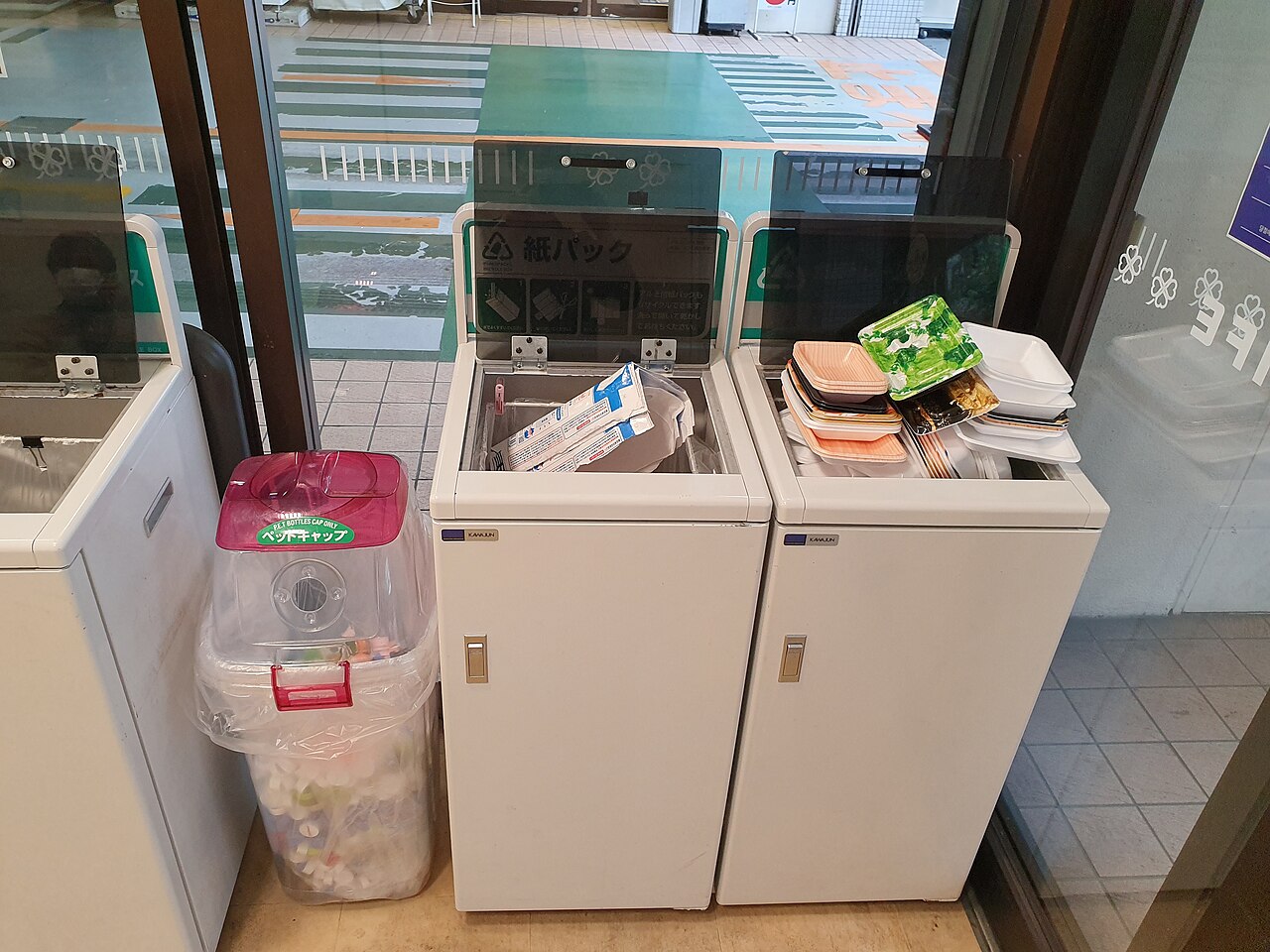
- Konbini bins sit by the door for that store's customers. Bought a coffee there? Locals treat the bin as covered by that purchase. The konbini toilet runs on the same logic, and that page has the sourced version of the argument.
- Vending-machine recycle boxes take bottles and cans only — from that machine, ideally. Not your bento box.
- Eat where you bought it. Street-food stalls generally expect you to eat nearby and return the container or use their bin.
- Stations: Tokyo's subway stations have no bins at all now; many JR East stations still do. Don't plan around them.
- Cities differ. Osaka's subway stations, for example, keep transparent bins near the ticket gates (Osaka Metro[EN]). Adjust expectations by city and operator, not by country.
Sources: Japan Tourism Agency — Travel Etiquette for the Future (EN)[EN] · Yahoo! News expert (dragoner)[EN] · Traffic News[EN] · Merkmal[EN] · Osaka Metro[EN] · Local voices: public X posts via Yahoo! Realtime Search, 2026-08-20. Last updated 2026-08-22.
Suggest the next place — or make this page better
Spotted something outdated? Know a place I should cover? Tell me below — it opens right here, no account needed. Every report is verified before publishing.