Mixed-Gender Onsen in Japan for Couples and Women: Why Konyoku Is Disappearing, and How to Visit the Survivors Without Meeting "the Crocodile"
Japan Logic — country-wide honne. Data collected 2026-08-22. Reviewed 2026-08-22.
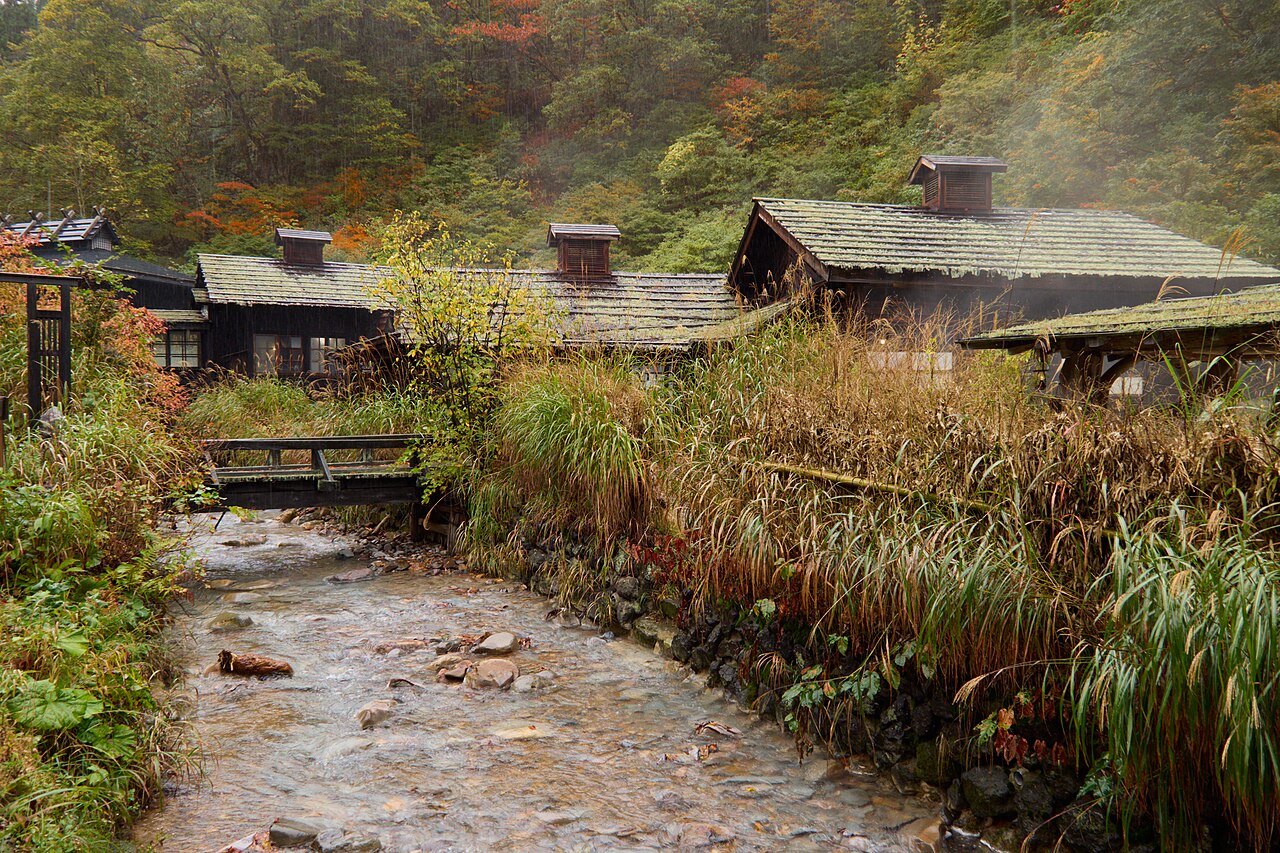
Terms, for first-timers — read this first: An onsen is a natural hot-spring bath; the word is also used for the town or inn built around one ("Nyuto Onsen" is a place). A ryokan is a traditional inn. A rotenburo is an outdoor bath. Japanese hot-spring bathing is nude: you undress in a changing room, wash thoroughly at a tap or shower, then soak in the shared tub; a small towel may be used for modesty while walking but is kept out of the water. Baths are gender-separated almost everywhere. Konyoku (混浴) — men and women in the same tub — is the rare exception, and it is shrinking. Yuamigi (湯あみ着) is a thin bathing garment (shorts for men; a sleeveless top and shorts for women) that some mixed baths rent or require. A kashikiri bath is a private bath you rent for your party — by definition mixed, and the easiest option for couples.
🧩 THE PUZZLE
You've heard Japan has mixed-gender hot springs. You look one up and find the same few names every time — Tsuru-no-yu, Sukayu — and a lot of forum posts saying "it's dying out." Nobody explains why it's dying, why the rules at each place contradict each other (nude here, bathing garment required there, women-only hours somewhere else), or what the Japanese word everyone at the bath quietly has in mind.
If you're a couple who simply want to bathe together: book a ryokan with a kashikiri (private) bath. Almost every inn has one, it's mixed by definition, and none of what follows applies. The rest of this article is for people who want the real communal konyoku — and especially for women deciding whether to.
📜 THE TATEMAE — the official rule
1. New mixed baths essentially cannot be opened. Bathhouses and inns are licensed by prefectures under the Public Bath House Act and the Inns and Hotels Act, and the national management guidelines behind those licences — first issued in 2000 and revised since — say that a shared bath in an inn must, as a rule, be divided by sex, with at least one bath for each, and that public bathhouses must separate men and women with a partition that can't be seen through (MHLW notice, 10 Dec 2020, 生食発第1210001号[EN]). Onsen experts state the practical consequence flatly: under current law, new mixed baths effectively cannot be built (Takahashi Kazuki, Yahoo! News Expert, 2026[EN]; Bengo4.com, lawyer Kobayashi Yasuhiko, 2022[EN]). Every konyoku you can still visit is a grandfathered survivor. When one converts to single-sex or closes, nothing replaces it.
2. Children aged about 7 and over can't bathe with the opposite sex. The 2020 revision set the national guideline at "about 7 and over — do not allow mixed bathing" (おおむね7歳以上の男女を混浴させないこと) (MHLW notice[EN]); prefectures have been amending their ordinances to match, lowering the line from the previous "about 10" (e.g. Shizuoka Prefecture, effective 2023-10-01[EN]). This is about children in the men's or women's bath, not about konyoku; it's why a family with a 9-year-old gets turned away from the "wrong" side of a hotel bath.
3. Secretly photographing someone's body in a bath is a national crime. Since 13 July 2023, Japan's Act on the Punishment of Photographing Sexual Images makes it a criminal offence to photograph a person's sexual body parts (or underwear) without a legitimate reason and without consent, and to distribute or upload such images (Ministry of Justice Q&A[EN]; Cabinet Office Gender Equality Bureau summary[EN]). A phone out at a konyoku is not a faux pas; it's a police matter.
4. The survivors publish their own rules — in Japanese — and they differ. Examples: - Sukayu Onsen (Aomori, northern Japan): the 160-tatami "Hiba Sennin-buro" is mixed; women-only hour 8:00–9:00 a.m.; since May 2024 rental yuamigi for both sexes, ¥500, 7:00 a.m.–8:00 p.m., wearing one is optional; only rented or purchased garments allowed — no bringing your own; day-use hours and prices change on 1 Dec 2026 (Sukayu official[EN]). - Kusatsu Sainokawara rotenburo (Gunma, ~3 h from Tokyo): normally gender-separated; mixed only on Friday evenings, 5:30–8:00 p.m., with a yuamigi required (rental ¥400 for women, free loan for men; swimsuits allowed; no children's sizes — bring a swimsuit for kids) (Kusatsu Onsen official). - Tsuru-no-yu (Nyuto Onsen, Akita): the famous traditional mixed rotenburo, milky water; visitors describe it as a no-garment bath, and it also has a women-only outdoor bath (Takahashi Kazuki[EN]; inn listing: Japan Association of Secluded Hot Spring Inns[EN]). We could not confirm the towel/garment rule on the inn's own site — ask when you book.
The rules are not standardized — they are per bath, and they are on the Japanese page.
📋 Rules at a glance
| Act | Rule | Penalty | Since | Level / authority | Source |
|---|---|---|---|---|---|
| Mixed bathing of children aged about 7 and over (in the men's or women's bath) Japan — public baths and inn baths | Not allowed — national guideline, implemented by prefectural ordinances | Facility rule; refused entry | 2020-12-10 (guideline date; ordinance dates vary by prefecture, e.g. Shizuoka 2023-10-01) | national MHLW guideline on hygiene management at public baths (notice 生食発1210第1号) → prefectural ordinances | MHLW notice (JA) verified 2026-09-07 |
| Secretly photographing a person's sexual body parts or underwear without legitimate reason; distributing/uploading such images Japan — any bath or changing room | Crime | Photographing: up to 3 years' imprisonment or a ¥3,000,000 fine (art. 2). Passing the image to someone: the same. Providing it to the public at large, or displaying it publicly: up to 5 years or ¥5,000,000, and both may be imposed together (art. 3(2)). Holding it in order to do either: up to 2 years or ¥2,000,000 (art. 4). | 2023-07-13 | national Act on the Punishment of Photographing Sexual Images (性的姿態撮影等処罰法) | Ministry of Justice explainer (scope and effective date); penalty amounts: e-Gov, Act No. 67 of 2023, arts. 2–4 verified 2026-09-07 |
The rules that apply here, one row each, with the authority level, the penalty and a source a human has checked. The whole dataset is published as rules.json (CC BY 4.0).
🗣️ THE HONNE — what locals actually say
The word you need is ワニ — wani, "crocodile." It means a man who sits motionless in a mixed bath for hours, positioned to watch the women's entrance. Anyone in Japan who has been to a konyoku knows the word; it almost never appears in English. Summarized from public Japanese posts on X (posts are paraphrased and grouped, not reproduced):
| Camp | What it sounds like |
|---|---|
| First encounter | Posters describing their first wani: a man who stared from the moment they entered and had brought a water bottle so he could stay in for hours — followed by "honestly, just ban mixed bathing." |
| The nostalgic | Older posters remembering when you said hello and got in and nobody stared, and saying some mixed baths have become a hassle because of it. |
| The newcomer | People who kept seeing "this onsen has crocodiles" in reviews, got alarmed, then learned it's slang. |
| The garment converts | Posts praising places with rental garments and women-only hours — Kusatsu's Friday-night mixed session, small mountain baths with clear water but rental yuamigi — as "easy ones for women." |
| The husband | A man noting the women-only hour was what made the trip work, because his wife would never do mixed. |
| The rule-readers | Posts relaying one inn's posted rules — mixed rotenburo, shared changing room, no swimsuits or towel-wraps, frequent women-only slots, bring a flashlight at night — a reminder of how specific each place is. |
| The enforcers | Posts reacting to someone filming in a bath: this is what kills mixed bathing, and it's a crime now. |
Methodology: posts were summarized, not reproduced; posts targeting nationalities were excluded.
The honne: locals are not defending konyoku as an erotic curiosity; they are mourning it as a communal culture that a small number of men spoiled. Women stopped coming; facilities went single-sex; the law won't allow replacements.
🤔 THE WHY — how it got this way
Once ordinary, then regulated. Mixed bathing was common enough that foreign visitors in the late Edo period (the 1850s–60s) remarked on it (Bengo4.com[EN]). Today's licensing follows national guidelines that assume separation (first issued in 2000, per the MHLW notice[EN]), so the survivors are old inns and communal baths — which is why konyoku today usually means remote, old, often austere.
Numbers. There is no official count. Onsen researcher Kitade Kyoko's tally, cited by Bengo4, has mixed-bath facilities falling to less than half in 28 years (Bengo4.com[EN]). Takahashi Kazuki's 2026 series is framed as "places to bathe once before they're gone" (Yahoo! News Expert[EN]).
How the baths responded. Bengo4 quotes lawyer and onsen writer Kobayashi Yasuhiko describing men camped by the women's entrance and groups calling out to young women; proper konyoku etiquette, he says, is that when a woman enters men turn their backs and don't speak to her (Bengo4.com[EN]). Baths responded with partitions, women-only hours and garment rules — each of which also makes the bath less "traditional," which is the tension.
The government experiment. The Ministry of the Environment's Towada-Hachimantai National Park office runs the "Konyoku in 10 Years" project (10年後の混浴プロジェクト) for the park's 20-plus hot-spring sites, many of them old therapeutic baths, aiming at mixed bathing that "women, sexual minorities, foreign tourists — anyone" can enjoy. It ran "yuamigi days" at Sukayu — five in November 2021 and three more in early 2022 — with everyone in garments and a survey afterwards: women made up a somewhat larger share of bathers on those days, and 70% of men and 80% of women said the garment removed their resistance to mixed bathing, while regulars were more negative, worrying about hygiene and the loss of the traditional feel; some voices also stressed keeping the experience available to visitors, foreign visitors included (MoE, 湯あみ着の日[EN]; additional days[EN]; results PDF; Bengo4.com[EN]). Sukayu's May 2024 move to optional rental garments for both sexes is consistent with that direction (Sukayu official[EN]). Expect both models to coexist — and check which one you're walking into.
Why the water matters. Many famous konyoku are milky or cloudy mineral baths. Locals mention this constantly because it's a privacy feature: once you're in, nothing is visible. Clear-water mixed baths are the ones where garments and women-only hours matter most.
✅ THE MOVE — do this instead
- Couples: start with a kashikiri (private) bath. It's mixed by definition and you skip the etiquette entirely. Larger ryokan and most onsen hotels have one; small inns often don't, and where they do it can be reservation-only or charged extra — so check the inn's own page rather than assuming. Communal konyoku is a different, more public experience; do it as a second step if you're curious.
- Read the Japanese page, not the English one. Search the inn's name plus 混浴 and run it through a translator. The countermeasures — 湯あみ着 (garment) policy, 女性専用時間 (women-only hours), sometimes "no men bathing alone" — are usually posted only in Japanese. Two minutes; it's the difference between bathing and being turned away or embarrassed.
- Know which of the three models you're in. (a) Nude-only, traditional — e.g. Tsuru-no-yu's mixed rotenburo; milky water, no garments or towels in the tub, changing rooms may be shared or separate. (b) Garment optional, rented on site — e.g. Sukayu (¥500, don't bring your own). (c) Garment or swimsuit required — e.g. Kusatsu Sainokawara on Friday evenings. "Konyoku" no longer tells you which.
- Women: here's what it looks like. Typically you undress in a women's changing room, wash, and enter the mixed tub by a women's door or a screened corner; in milky water you're invisible once seated. Where the changing room is shared (rare, and posted), you can keep a yuamigi or a large towel on to the tub edge — or treat that inn as one to visit during the women-only hour instead. I have not found a posted rule either way; it's your call. Sukayu's is 8:00–9:00 a.m.; many inns schedule several slots a day for staying guests.
- Men: don't be a wani. A wani — "crocodile" — is a man who sits motionless in a mixed bath for hours in a spot that watches the women's entrance (see above). Get in, soak, look at the mountains. The one rule of konyoku etiquette I found stated outright in a published source is Kobayashi Yasuhiko's, in Bengo4: when a woman enters, men turn their backs and don't speak to her (Bengo4.com[EN]). Beyond that there is no posted code — not sitting facing the entrance and not tracking anyone's movement are simply the behaviours the complaints above are complaints about. Nobody at the bath will say any of this to you.
- Phone stays in the locker. Secret photography in a bath is a crime with national reach since 2023, and even a "just the scenery" shot gets you thrown out.
- Expect austere, and plan the trip around it. The surviving baths are old and rural — Sukayu and Nyuto are in Aomori and Akita, northern Japan, roughly 3 hours from Tokyo by Shinkansen plus a bus; Kusatsu is in the mountains about 3–4 hours from Tokyo. Some have a cold-water pipe instead of showers. The journey is half the experience.
Sources: MHLW, 公衆浴場における衛生等管理要領等の改正について, 2020-12-10[EN] · Shizuoka Pref., mixed-bathing age ordinance[EN] · Ministry of Justice Q&A on the 2023 Act[EN] · Cabinet Office, 性的姿態撮影等処罰法 summary[EN] · Sukayu Onsen official information[EN] · Kusatsu Onsen — Sainokawara mixed bathing · MoE Tohoku, 10年後の混浴プロジェクト — 湯あみ着の日[EN] · MoE Tohoku, additional days[EN] · MoE Tohoku, results PDF · Bengo4.com, 2022-03-10[EN] · Takahashi Kazuki, Yahoo! News Expert (Tohoku), 2026[EN] · Japan Association of Secluded Hot Spring Inns — Tsuru-no-yu[EN] · Local voices: public X posts via Yahoo! Realtime Search, 2026-08-22. Last updated 2026-08-22.
Suggest the next place — or make this page better
Spotted something outdated? Know a place I should cover? Tell me below — it opens right here, no account needed. Every report is verified before publishing.